

I got the news alert at 2 AM yesterday. Google and SpaceX are in advanced talks to build data centers in orbit. Not “studying the feasibility.” Not “exploring the concept.” Actually moving forward with plans to launch AI infrastructure above the atmosphere.
When I first read it, my gut reaction was skepticism. We’ve heard moonshot promises before. But then I started digging into the details, and something shifted. This isn’t hype. It’s real, it’s ambitious, and the timing is wild.
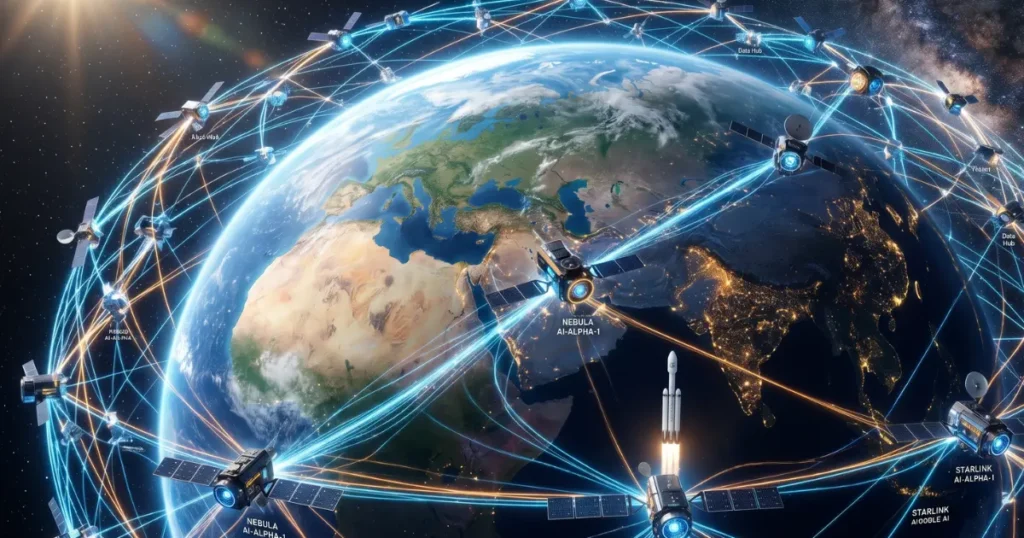
Google and SpaceX orbital AI data centers are being developed to solve the growing AI power crisis. Learn how space computing may transform tech.
Why the Tech World Just Had a Collective “Wait, What?” Moment
The Wall Street Journal broke the story on May 12, 2026, citing sources familiar with the talks. Google is negotiating a rocket-launch deal with SpaceX to move orbital data centers from the theoretical realm into actual hardware. This comes right as SpaceX is preparing for what could be the largest IPO in history—a $1.75 trillion market debut expected as soon as June 2026.
Let that sink in. Two tech giants that have spent years circling each other as both allies and competitors are about to partner on infrastructure that sounds straight out of a sci-fi novel.
But here’s the thing that makes this real: Google isn’t betting on SpaceX alone. The search giant is also in talks with other launch providers—likely Blue Origin, Rocket Lab, or the United Launch Alliance—keeping its options open. This isn’t desperation. This is leverage. This is a company serious about launching actual hardware within the next couple of years.
Also visit : Prompts
Why This Matters: The Earth-Based Data Center Crisis Is RealBefore we get to the space part, you need to understand the problem on the ground. AI is eating electricity like nothing we’ve ever seen before.
Data centers globally will consume nearly 1,000 terawatt-hours of power by 2030, roughly double what they use today. For context, that’s equivalent to the total electricity consumption of some entire countries. The challenge isn’t that we can’t generate that much power—it’s that we can’t do it where companies need it, and we’re running out of water to cool the equipment.
I covered this beat last year when Michigan township voted to block water deliveries to a new hyperscale data center. It’s not an isolated incident. It’s happening everywhere. Communities don’t want them. Regulators are getting stricter. Power grids are congested. Environmental pushback is real.
Companies like Google and Microsoft are literally hunting for solutions. Google is restarting nuclear plants. Microsoft is striking deals with power generators. Everyone’s scrambling.
But what if you could just… skip all of that?
The Physics That Changes Everything
This is where orbital data centers stop being a pipe dream and start looking like actual strategy.
A solar panel in orbit can produce up to 8 times more energy than the same panel on Earth. Why? No atmosphere. No clouds. No night (at least not in a sun-synchronous orbit, where satellites stay in continuous sunlight). The solar constant in low-Earth orbit delivers roughly 1,361 watts per square meter of pure, unfiltered energy.
Let me put that another way: the sun produces 100 trillion times more energy than all of human civilization generates today. Tapping even a fraction of that without atmospheric losses completely changes the energy equation.
Then there’s cooling. On Earth, data centers spend 40-60% of their operating costs on power and cooling, especially for AI workloads that generate massive heat. In space? The vacuum itself is your cooling system. Heat radiates away passively. No water. No giant chillers. No fans burning energy.
Elon Musk has claimed orbital data centers could be cheaper to operate than terrestrial ones within two to three years. Academic experts call that “optimistic,” but they don’t say impossible. They say it requires better rockets, better cooling tech, and lower launch costs. SpaceX, with its Starship program, is betting it can deliver all three.
Also visit : Gemini
Google’s Project Suncatcher: The Prototype Phase
Google announced its orbital data center initiative, Project Suncatcher, last November, but most tech press glossed over it. Now it’s the centerpiece of the SpaceX negotiations.
Here’s the plan: Google will launch two prototype satellites by early 2027, in partnership with Planet Labs, a satellite-imaging company. Each satellite will carry Google’s custom-designed TPU chips—the same processors that power Gemini, Google’s flagship AI model.
Why prototypes first? Because sending expensive hardware to space to test if it survives radiation, thermal stress, and the vacuum is not something you want to learn the hard way. Google wants to validate:
- Whether TPUs can handle the radiation environment of low-Earth orbit
- If two satellites can coordinate compute tasks across optical laser links (terabit-per-second connections using light beams)
- Whether the whole system is economically viable at scale
If it works—and Google’s betting it will—the vision scales fast: an 81-satellite constellation in sun-synchronous orbit, all connected by laser links, forming a distributed AI cloud.
CEO Sundar Pichai put it bluntly: “We’ll send tiny racks of machines and have them in satellites, test them out, and then start scaling from there. Within a decade or so, this will be a more normal way to build data centers.”
A decade sounds long until you realize we’re not just talking about a new feature. We’re talking about a fundamental shift in how computing infrastructure works.
SpaceX’s Ambition: One Million Satellites
While Google is playing it measured with 81 satellites, Elon Musk is thinking bigger—way bigger.
SpaceX has proposed launching upward of one million satellites to form an orbital data center constellation. Each satellite in Musk’s vision would carry AI compute capacity, and they’d be positioned around Earth’s poles to maximize coverage and power generation.
Musk even unveiled the first generation “AI Sat Mini” spacecraft with solar arrays spanning roughly 180 meters (about 600 feet).
Now, before your brain breaks trying to picture a million satellites, understand that this isn’t just Musk being Musk. It’s a calculated business move. SpaceX is about to go public, and orbital data centers are the growth story it’s selling to investors. A partnership with Google? That’s not just good optics. That’s validation that the world’s largest search company thinks this is viable.
The Skeptics Aren’t Wrong
Here’s where I need to push back on the hype. Because even though the physics is compelling, the engineering challenges are massive.
Launch costs are still brutal. It currently costs around $1,000 per kilogram to launch a satellite into orbit. Google believes that cost needs to drop to $200 per kilogram before orbital data centers make economic sense at scale. SpaceX’s Starship is supposed to get us there, but Starship is still in development and testing. It’s not a proven, operational system yet.
Then there’s the cooling problem. Yes, space is cold. But it’s also a vacuum, which means heat can’t dissipate through convection or conduction—it has to radiate away through specialized heat radiators. Those radiators are heavy. Heavy means expensive to launch. The technology exists (the International Space Station uses them), but scaling it up for data center-level heat loads is unproven.
Brandon Lucia, a professor at Carnegie Mellon who specializes in space computing, told NPR that Musk’s two-to-three-year timeline is “an optimistic interpretation.” Translation: it might take longer.
There’s also the latency question. Even at the speed of light, the delay between satellites in orbit can add up. For some AI workloads, that’s fine. For others, it’s a deal-breaker. Google’s solution is flying satellites in extremely tight clusters to minimize latency, but that adds complexity.
And then there’s the astronomy problem. SpaceX’s million-satellite proposal has already generated serious objections from astronomers who argue that millions of bright moving objects in the night sky would severely impair ground-based observations. The FCC put SpaceX’s application on a “fast-track” approval process, which astronomers say bypassed normal environmental review.
Google and SpaceX orbital AI data centers are being developed to address the growing AI power crisis. Google and SpaceX orbital AI data centers could transform how cloud computing works by moving data processing into space. With unlimited solar energy and advanced satellite networks, Google and SpaceX orbital AI data centers may reduce dependency on Earth-based power grids and cooling systems. This innovation could reshape the future of artificial intelligence infrastructure and global computing systems.
What This Means for the Tech Industry
If this works—and that’s a real if—it fundamentally reshapes tech infrastructure economics.
Power becomes cheap. Data centers operating on solar energy in orbit, with essentially zero marginal electricity costs once deployed, would undercut terrestrial facilities that pay for grid electricity.
Scale becomes easier. Today, if you want to build a 5-gigawatt data center on Earth, you need to find land, negotiate with local governments, secure water rights, and convince regulators it won’t destroy the grid. In orbit? You just launch more satellites.
Location constraints disappear. Current data centers have to be where power is available and permitting is friendly. Orbital data centers can serve any part of the planet equally.
But there’s a catch: this only works if companies solve the engineering and cost challenges. And honestly, nobody’s there yet. Google’s being smart by running prototypes first. SpaceX is being ambitious—maybe too ambitious with the million-satellite vision, but ambition is how breakthroughs happen.
The Real Timeline
Don’t expect orbital data centers to be cheaper than ground-based ones this year or next. But Google’s prototype launches in early 2027 will tell us whether the concept is actually viable or if it’s another billionaire moonshot that never quite lands.
The next 18 months matter. If Google’s satellites work, if the laser links hold stable, if the TPUs survive radiation—then we’re looking at a genuine shift in how the tech industry builds infrastructure.
If something breaks or underperforms, we’ll all be reading think pieces about how space wasn’t the answer after all.
The Bottom Line
Google and SpaceX aren’t just talking about orbital data centers. They’re moving toward actual deployment. Two prototypes launching in 2027. Advanced partnership talks happening now. An IPO valuation partly built on this vision.
Is it going to work exactly as promised? Probably not. Technology rarely does. Will it be cheaper than Earth-based data centers in two years like Musk claims? Almost certainly not. But does it represent a genuine attempt to solve a real problem—the power and cooling crisis of AI—by thinking bigger than incremental improvements?
Absolutely.
That’s what makes this different from past hype cycles. This isn’t theoretical anymore. Hardware is being built. Deadlines are set. Capital is committed.
The age of data centers in space just stopped being science fiction and started being business strategy. And May 12, 2026, is the day we found out just how serious these companies are about making it happen.
Have questions about how orbital data centers would actually work, or why this matters for AI development? The tech behind this is genuinely interesting, and I’m happy to dig deeper on any angle